Charlie Supersynski
Copper Peak, Inc.
supercynski@gmail.com
The Golden Era of Ski Jumping
The decade preceding WWII could be defined as the Golden era of ski jumping in the United States. There were more ski jumps and ski jumpers than at any other period in the history of the sport. In the Midwest in the late 1930’s, Michigan had 17 ski jump facilities at which formal, sanctioned competitions were held. Similarly, Wisconsin had 27 such sites and Minnesota had 16 sites. Even States, such as Illinois, Iowa, South Dakota and North Dakota, with unlikely topography and weather had a number of ski jumping facilities.
Throughout the Midwest there were also many communities with non-sanctioned hills created by up-and-coming young ski jumpers. Many of these ski jumps were only utilized for a few years and disappeared because skiers outgrew the hills or community interest waned. Ski jumping was the sport of choice during winter months as downhill skiing utilizing rope tows and or chair lifts to transport skiers was only in its infancy in the 1930’s. Recreational downhill skiing grew rapidly following WWII as a competitive sport to ski jumping. World War II put a halt to ski jumping meets across the country as only a few sanctioned competitions were held.
A similar story could be told about ski jumping out east and west as these areas of the country experienced a rapid growth in the sport of ski jumping during the 1930’s. The sport was enhanced by the influx of ski jumpers to this country prior to WWII particularly from Norway and other Scandinavian countries. Many were Olympic caliber athletes.
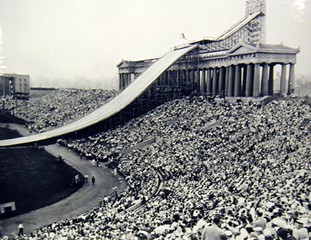
Several competitions standout: The Chicago Sun Times arranged to have a 184 foot high ski jump tower—probably the largest in the world—built on the edge of Soldier Field with the landing area inside the stadium. One-hundred forty ski jumpers participated in front of 57,000 fans on Feb. 7, 1937. The Gogebic Range Ski Club (GRSC, Ironwood, MI) sent 15 ski jumpers, the largest contingent of skiers representing any club. Four of them participated in an exhibition of the “Shooting Star” where the skiers follow one another only seconds apart. A strong wind limited distances jumped to 140 feet. They skied on 1,000,000 lbs. of crushed ice.
On March 4, 1938, a 151-foot ski jump tower had been built on the edge at the Los Angeles Coliseum where ski jumpers competed before 88,000 spectators on a 60-meter hill constructed in the stadium. Five hundred tons of crushed ice were utilized.
In 1938 the Kings Gateway Hotel in Land ‘O Lakes, WI, (60 miles East of Ironwood, MI) built a 100 ft. ski jump tower and Landing slope (30-meter hill) on the flat topography of the golf course. They invited the best ski jumpers to compete in exhibition and sponsored one of the first Nordic Combined meets in the Midwest.
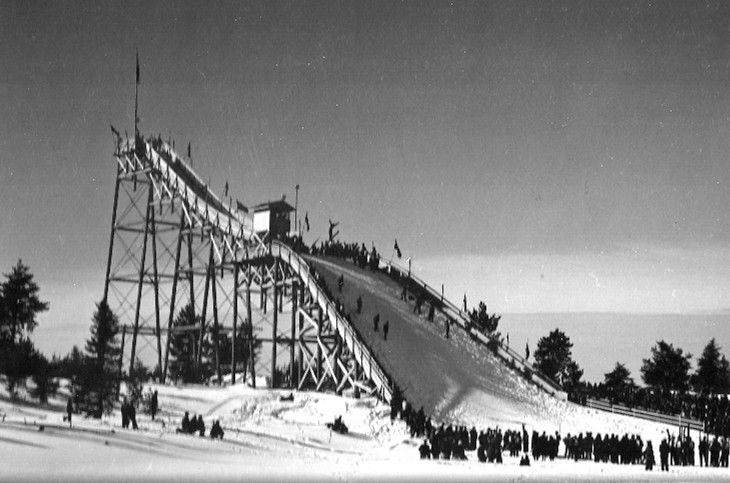
The GRSC hosted 103 ski jumpers at its annual meet at Ironwood’s Wolverine Hill in 1937. That year the GRSC was the winningest ski club in the Midwest with 22-1st places, 8-2nd places and 14-3rd place finishes while the next best club, Ishpeming, finished with 13-1st places, 23-2nd places and 7-3rd places. The GRSC had nine sets of brothers competing.
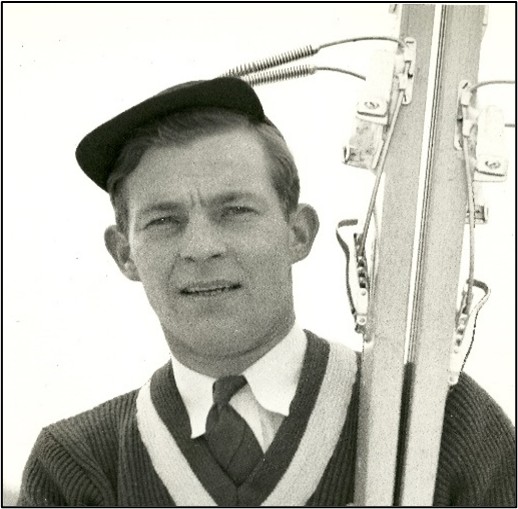
The USA met for the first time Torger Tokle, the talented ski jumper who emigrated from Norway to the New York City on Jan. 21, 1939. One day later he competed at his first meet at Bear Mountain, NY (an hour’s drive from NY City in the valley of the Hudson River) and set a new hill record of 180 feet. A month after his arrival in NY, Torger bested the USA ski team at their Olympic qualifying meet in Berlin, NH on Feb. 26, 1939.
Over the three seasons ending in 1942, Tokle would compete in 38 meets of which he won 35 and set 19 hill records. Of his 450 jumps he only fell five times and never had an injury. Torger was drafted into the US Military and lost his life in battle in the Apennines in Northern Italy in 1945. Without a doubt he is the USA’s most talented and distinguished ski jumper.
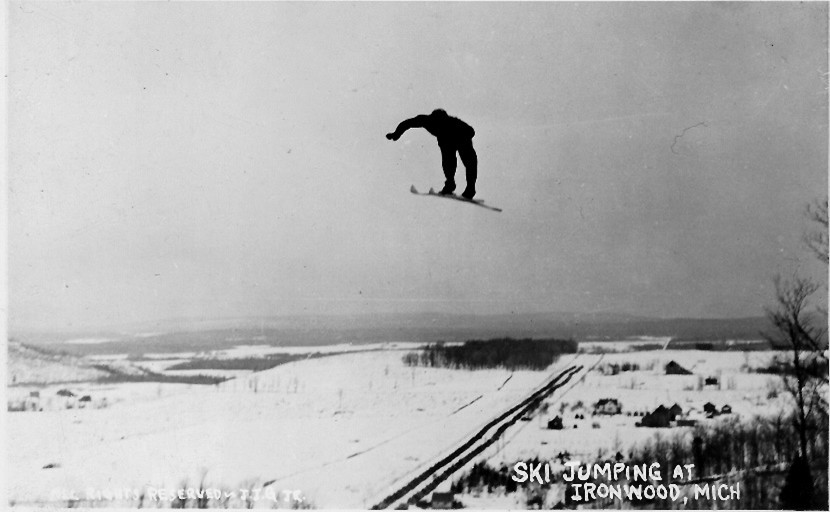
The photo below shows Tokle competing at Ironwood’s Wolverine Hill in 1942 where he set a distance record of 216 feet which was never broken. Note the tremendous height over the knoll. During that time frame the take-off angle was set at each hill and varied from flat to about 8 degrees down. Sometimes a ‘kicker’ (a slight upward angle) was put on the take-off. Skiers with the greatest upward (and outward) lift at the take-off achieved the longest distances. Because of the great heights reached, landings were very hard. Today, the angle of the take-off on sanctioned hills varies from 10 – 12 degrees down and skier flights more closely follow the landing slope. It was rumored that Tokle had such strong leg strength that he could leap with full military gear from a squat into the box of a five ton military truck.