JIM THIELEN
Minneapolis Ski Club
Eau Claire, WI
jp_thielen@yahoo.com
Want to Make a Swap? An Exchange with Bjorn Wirkola, Norway
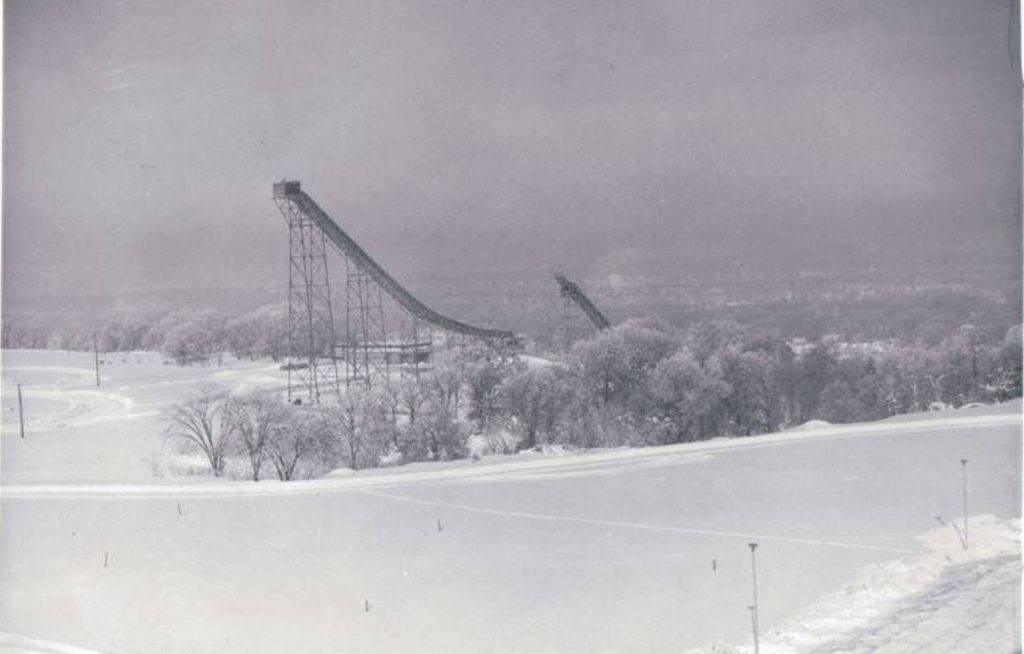
The date was March 3, 1968. The hill was Hendrickson Hill in Eau Claire, Wisconsin. The scaffolding was a legacy structure that had been repurposed a couple of times and eventually became part of the scaffolding for the Silver Mine Hill.
Hendrickson Hill was a senior circuit event, but not significantly larger compared to my home hill, Bush Lake Ski Jump in Minneapolis. The design of the hill was much like Bush Lake. The Eau Claire Ski Club has a history of hosting very good events that attract large crowds of spectators. For me, it was an easy day trip and a new challenge at the end of the season. A couple of junior skiers joined some of the senior members from the Minneapolis Ski Club, who travelled to Eau Claire to compete in the event. It was an open weekend in the schedule before travelling to Bozeman, Montana, for the U.S. Junior National event. That’s another story.
It was a perfect day for a ski jumping event—temperatures in the high twenties, a breeze from the northwest and hard, crystallized snow conditions. The sky was overcast; the weather made for fast, consistent speeds. It was a perfect day for a ski jumping event!
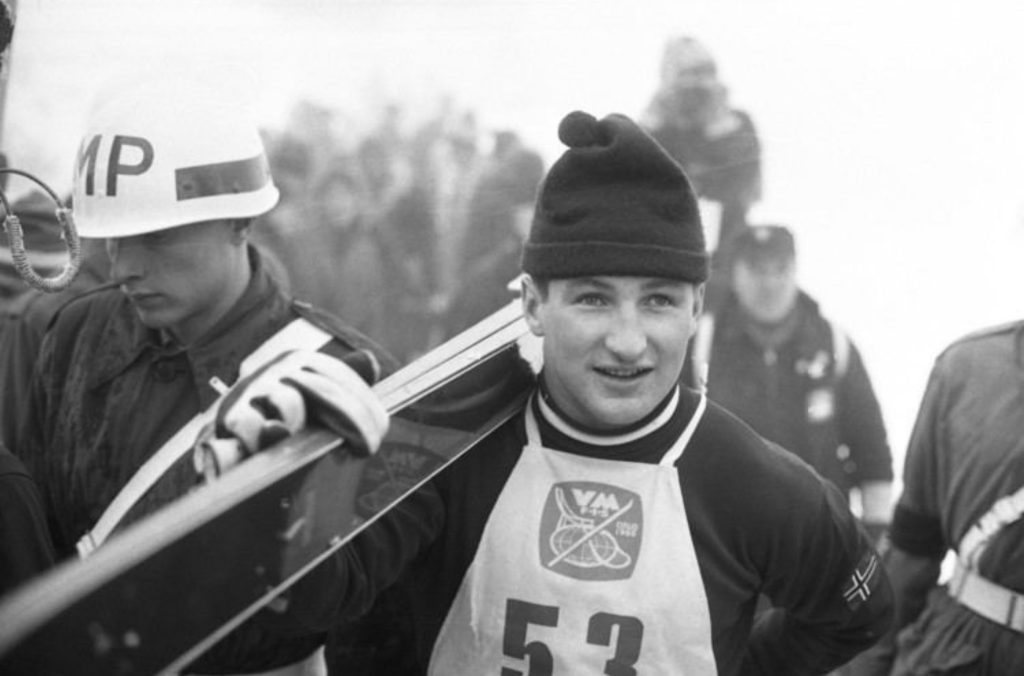
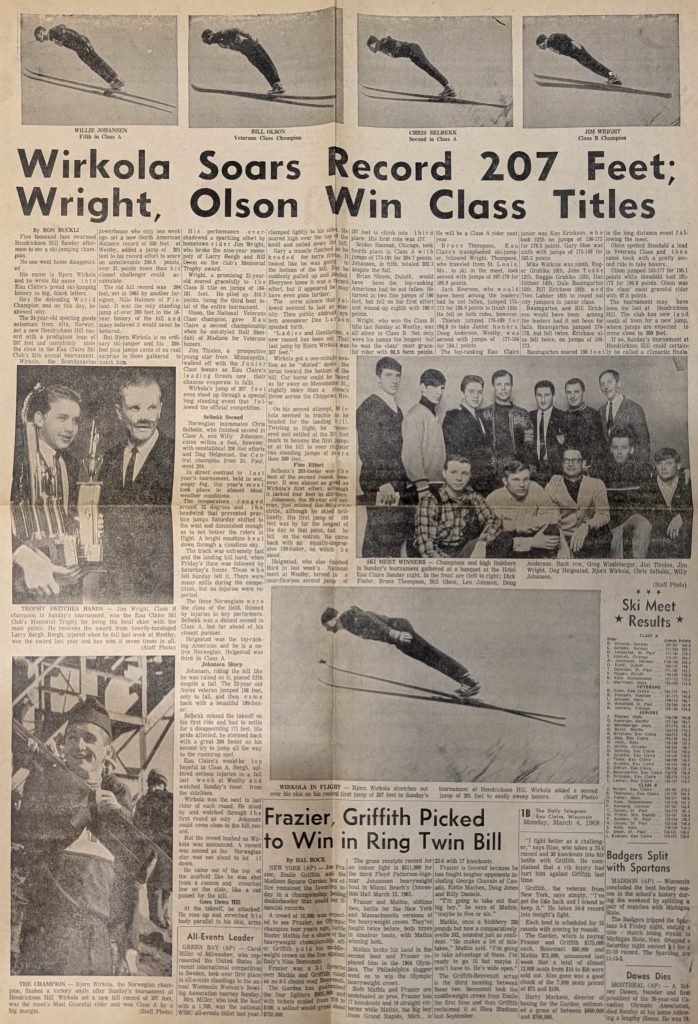
A contingent of skiers from Norway was travelling among the senior ski jumping events in the Central Division. The group included Bjorn Wirkola, the “Tiger Woods” of his day. When Bjorn was in the starting gate and smiling (Bjorn would literally have a big smile on his face in the starting gate), everyone else was competing for second place. He had a grace and style to his ski jumping that was unmatched. He combined remarkable consistency with natural talent, becoming a world-class skier. He was the benchmark by which all other ski jumpers were measured. Bjorn set a new hill record on that day at Hendrickson Hill, with two jumps over two hundred feet. His first jump of 207 feet was a new hill record.
The results of the event are attached along with a full-page article from The Daily Telegram, a newspaper published in Eau Claire on March 4, 1968. I won the Junior Class competition. At the end of the day, the Eau Claire Ski Club conducted a banquet and awards ceremony for the competitors and club members. Instead of trophies, the awards were consumer products donated by sponsors and advertisers. When a skier was recognized, they were allowed to select one of the consumer products that were displayed on a table. As the overall winner of the event, Bjorn made the first selection, a power drill. When I made my selection, I chose a set of golf clubs. After the awards ceremony ended, Bjorn came to me with a person to translate a request; Bjorn asked if I would be interested in swapping our prizes. He recognized that a power drill from the United States would not work on the European power standard. I agreed, and I still have the Manning Bowman power drill.
Hey, Bjorn, do you still have the golf clubs?
You can also Venmo this year! To donate, find us at @usaskijumping
Or send a check to:
USA Ski Jumping
PO Box 982331
Park City, UT 84098



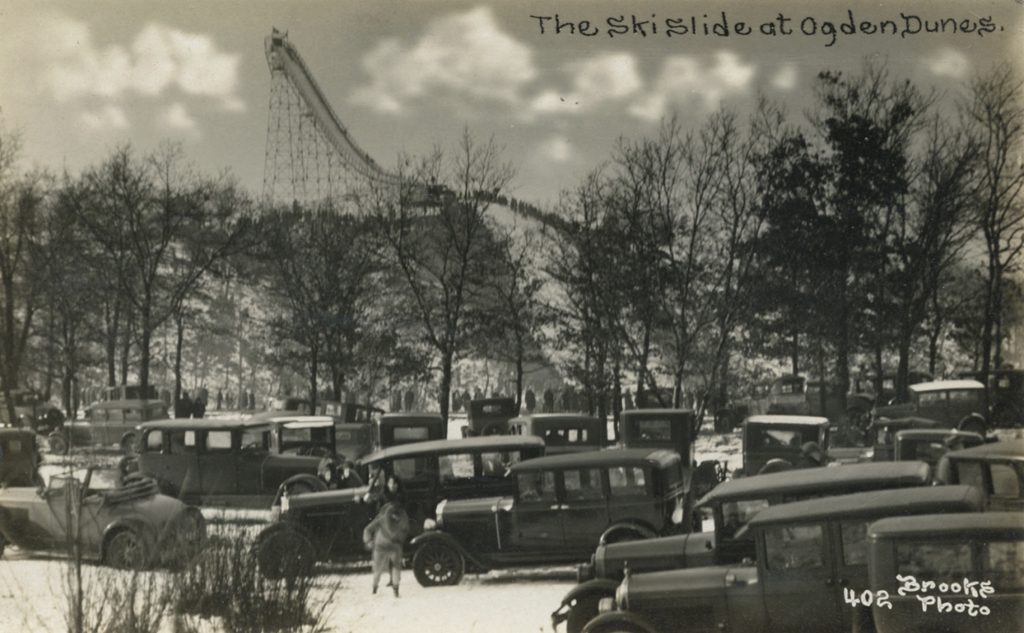
In 1927, members of the Grand Beach Ski Club (later known as the Ogden Dunes Ski Club) decided to build a modern ski jump on one of the highest dunes in northwestern Indiana. The result was an impressive structure: a steel-and-wood tower approximately 192–225 feet (59–69 meters) tall, with an inrun of 345 feet (105 meters), allowing speeds of up to 60 mph (around 97 km/h). The entire project cost $40,000.
The facility was completed and opened in January 1928. At the time, it was considered the largest artificial ski jump in America—possibly even in the world.
The first competition took place on January 22, 1928, attracting thousands of spectators. The site quickly became a venue for international events, drawing top athletes from the USA and Norway. During its heyday, the hill hosted ski jumpers such as Anders Haugen—the first American Olympic medalist in ski jumping (bronze, Chamonix 1924, awarded retroactively in 1974), regarded as a pioneer of the sport in the U.S.; Henry Hall—four-time U.S. champion (1914–1921), world record holder for distance (1921, 218 feet / 66 meters), known for his technical style and for promoting skiing in the Midwest; Casper Oimoen—1932 Lake Placid Olympian, originally from Norway but representing the USA, known for his dynamic technique and multiple national titles; and the Ruud brothers—Birger, Sigmund, and Asbjørn—who held Olympic (Birger) and World Championship titles (all three).
In 1932, during a visit by the Norwegian national team, the hill record was set at 195 feet (59 meters). It was achieved by one of the Norwegian jumpers—Birger Ruud, Kaare Wahlberg, or Hans Beck—though available sources do not document which one exactly.
Due to financial difficulties and waning public interest, competitions ceased after the 1932 season. In 1935, the entire structure was sold and transported to Rockford, Illinois, where it served the local ski club. In 1955, the tower was moved to Eau Claire, Wisconsin, where it operated for over a decade as the Hendrickson Hill ski jump. Then, in 1968–1969, it was once again dismantled and relocated within Eau Claire, becoming the main structure of the newly established Silver Mine Hill ski jump.
In 1997, a historical marker was installed near the original location of the jump (in the Kratz Park area of Ogden Dunes), commemorating its existence. The plaque is located at 82 Hillcrest Road and remains the only physical trace of Indiana’s greatest ski jump.
CREDIT- https://www.skisprungschanzen.com See more on the Ogden DUnes, IN ski jump by clicking HERE